
The List Family: Calculated Evil Disguised as Religious Salvation

When a Desperate Accountant Became an Unrepentant Mass Murderer
On November 9, 1971, in the prosperous New Jersey suburb of Westfield, John Emil List methodically murdered five family members and then spent nearly eighteen years building a completely new life under an assumed identity, remarrying without disclosing his crimes, and demonstrating a chilling absence of remorse. His carefully planned familicide stands as one of America’s most disturbing examples of how religious delusion, financial desperation, and calculated premeditation can weaponize a family home into a tomb.
The bodies would not be discovered for twenty-eight days. The classical music would still be playing through the intercom. The lights throughout the house would remain on. And John List would be sitting comfortably in Denver, Colorado, beginning his new life as Robert Clark.
The Victims: Five Lives Erased
The tragedy of the List family is not reducible to the crime scene statistics—five dead, one perpetrator, two handguns. Each victim possessed irreplaceable human dignity, distinct relationships, and unfinished dreams. The investigation into this case demands that their identities be honored and their stories told.
Helen Morris List (45)
Helen Morris List was born in 1926, the widow of an Army officer killed in action during the Korean War. She had been a devoted single mother to her daughter, Brenda, when John List met her at Fort Eustis, Virginia, in 1950. To secure his commitment, Helen told John she was pregnant—a deception that would haunt their relationship. When John discovered the truth after their December 1951 marriage in Baltimore, he felt betrayed. Yet his strict Lutheran upbringing forbade divorce.e
What John did not know, or perhaps chose to ignore, was that Helen’s medical condition was deteriorating. She suffered from tertiary syphilis, a disease she had hidden from her doctors, her family, and her husband for years. The progressive neurological damage manifested as brain deterioration, failing eyesight, addiction to tranquilizers, and a daily alcohol consumption of four to five glasses of Scotch. Helen remained largely confined to bed due to an overwhelming fear of falls. Yet to casual acquaintances, she maintained a façade of normalcy—a woman compartmentalizing unbearable physical and psychological suffering.
By 1971, after twenty years of marriage and having borne three children with John, Helen had withdrawn from the church that had defined her family identity. She requested her name be removed from the rolls ofthe Lutheran Church of the Redeemer. Whether this represented a genuine crisis of faith or a desperate attempt to distance herself from the hypocrisy she perceived in her husband’s behavior remains unclear. What is certain: John List perceived her religious decline as a spiritual emergency requiring intervention.
On the morning of November 9, 1971, Helen sat at the kitchen table drinking her morning coffee, unaware that her final moments had arrived. John approached from behind and shot her in the head, intending—in his own words—to spare her pain. He then dragged her body into the ballroom and placed her on a sleeping bag.
The Breeze Knoll mansion in Westfield, New Jersey, where John List murdered five family members on November 9, 1971
John Frederick List Jr. (15)
John Junior, called Johnny or John Jr. by the family, was the eldest son and, by all accounts, John Sr.’s favorite. The fifteen-year-old embodied the values his father professed to cherish: athletic excellence, academic achievement, and an outward appearance of propriety. On the morning of his death, his father watched him play soccer from the bleachers, observing his son’s athletic grace and competence—qualities John Sr. had either lacked or lost in his own declining fortunes.
After the soccer game, John Sr. drove his namesake home. What happened next suggests that young John either recognized something profoundly wrong or attempted to resist what was occurring. The forensic evidence paints a brutal picture: young John was shot not once, but ten times—shots from both handguns, delivering bullets to his chest and face. Unlike his sisters and younger brother, who died instantly from single shots to the back of the head, John Jr. experienced violence, struggle, and the terror of comprehending that his own father was attempting to murder him.
He was placed on a sleeping bag in the ballroom with the rest of the family.
Patricia List (16)
Patricia, called Patty by those who knew her, was sixteen years old, a high school junior at Westfield High School, and a vibrant member of the drama club. She possessed the creative ambition and theatrical sensitivity that would have allowed her to pursue her dream of becoming an actress—a profession that her deeply religious father viewed as inherently corrupt and morally indefensible.
Patricia had experienced enough family turmoil to raise alarms among her teachers and friends. She had been arrested for breaking curfew in an incident that her father perceived as a catastrophic violation of the family’s public image. She had warned friends that something would happen if she didn’t attend school, suggesting a troubled awareness that her family was disintegrating.
Her last point of contact with the outside world was her drama teacher, Mrs. Barbara Sheridan, to whom John Sr. had called, claiming that Patricia would be absent from rehearsal because the family had taken an impromptu plane to North Carolina to visit a sick relative. Mrs. Sheridan later stated she was the last person John List spoke to before the murders.
Patricia arrived home from school in the early afternoon. She was shot once in the back of the head and placed on a sleeping bag in the ballroom with her mother and brother.
Frederick List (13)
Frederick, the youngest child, was thirteen years old and, like his siblings, would never have the opportunity to become who he might have been. The evidence regarding Frederick is sparse—a teenager whose life ended before it truly began, whose personality and potential are lost to history because his father decided that poverty and spiritual decline were threats worth murdering to prevent.
He arrived home from school in the early afternoon and was shot once in the back of the head. His body was placed on a sleeping bag in the ballroom with the rest of his family.
Alma List (84)
Alma List, John Sr.’s mother, was eighty-four years old and living on the third floor of the Breeze Knoll mansion. A strict Lutheran like her son, Alma represented the religious legacy that John professed to honor. Yet on November 9, 1971, John Sr. murdered her with calculated coldness, kissing her “like Judas”—his own description—before shooting her above the left eye.
John justified his mother’s murder by claiming she would not have been able to bear “the tremendous shock” of discovering the other deaths. In truth, Alma was murdered to prevent her from discovering the bodies and alerting authorities. A postscript in his confessional letter revealed the callousness of his regard: “P.S.Motherr is in the hallway in the attic – 3rd floor. She was too heavy to move.”
She would be buried not in Westfield Cemetery with her family, but in her hometown of Bay City, Michigan, her body separated from her family’s grave by both geography and John’s pragmatic consideration of body weight.

Memorial tribute to the five victims of the List family murders
The Perpetrator: John Emil List, Accountant and Sunday School Teacher
John Emil List was born on September 17, 1925, in Bay City, Michigan, to German-American parents who were devout Lutherans. As an only child, he inherited both his father’s religious devotion and his tendency toward rigid thinking and control. After his father died in 1944, John absorbed his mother’s stringent expectations and her uncompromising moral framework. During World War II, John enlisted in the Army at age eighteen and served as a laboratory technician. After his discharge in 1946, he attended the University of Michigan, earning both a bachelor’s degree in Business Administration and a master’s degree in Accounting. He also earned a commission as a second lieutenant through ROTC.
When the Korean War erupted, and John was recalled to active duty in 1950, he was stationed at Fort Eustis, Virginia, where he met Helen Morris Taylor at a
church social. Within months, he was convinced that Helen was pregnant. When it became clear that she had deceived him, John felt personally wronged. Yet his religious convictions prevented him from considering divorce. He would spend the next twenty years in a marriage founded on deception, trying to control a woman who was slowly deteriorating physically and emotionally.
John’s career in accounting followed a trajectory of moderate professional success until his termination in 1971. He had worked as a vice president of a Jersey City bank, and before that as director of accountancy at Xerox in Rochester, New York. He had lived in multiple states, presented himself as respectable and reliable, and built a reputation as a conscientious professional. Yet his professional achievements were always shadowed by an inability to acknowledge failure, an incapacity to communicate honestly, and a self-righteous conviction that he alone understood what was right for his family.
The Financial Crisis That Triggered Everything
By 1971, John List’s financial situation had become dire. His employer had fired him, but John could not bring himself to inform his family of his unemployment. For approximately six months, he maintained the fiction that he still had a job, spending his days at the local train station, reading newspapers, and napping while his wife and children believed he was at work.
His home, the Breeze Knoll mansion—a 19-room Victorian estate that had seemed like the manifestation of American success—was approaching foreclosure. He had been systematically siphoning money from his mother’s bank accounts to maintain the appearance of solvency. On November 9, 1971, he cashed bonds totaling approximately $2,000
Yet in an irony that would echo through the decades, the mansion itself contained a solution to every financial problem List faced. An original, signed Tiffany skylight installed in the property would have sold for sufficient capital to resolve all debts, maintain the family through an extended period of unemployment, and preserve the façade of stability that List so desperately clung to. Instead of removing and selling the skylight, John List chose to murder his family. One year after the murders, the mansion burned in a fire of undetermined origin, destroying the very skylight that could have saved them all.
Religious Obsession as Justification
John List was not a mere murderer responding to a financial crisis through criminal violence. He was a murderer who had constructed an elaborate religious justification for familicide. As a Sunday school teacher in the Lutheran Church of the Redeemer, he had access to theological language and religious authority. He weaponized both to rationalize mass murder.
In his view, the 1970s would be a dark and spiritually compromising decade. His daughter Patricia aspired to become an actress—a profession he equated with moral corruption. His wife had requested removal from the church rolls. His son might fall away from faith. Poverty and welfare would expose his family to shame and spiritual decline. The only solution, in List’s distorted theological framework, was to ensure their salvation by killing them before they could stray further from grace.
The psychiatric evaluation conducted after his arrest would be damning. Dr. Steven Simring, who examined List in prison, found “no evidence of genuine remorse. He’s a cold, cold man.” An intelligence quotient of 140 had not saved him. Indeed, his high intelligence had enabled his crimes by allowing him to plan meticulously, deceive consistently, and rationalize ruthlessly.
November 9, 1971: The Execution of a Family
The meticulous planning and calculated execution of the List family murders stand as testimony to John’s capacity for deliberate violence and premeditation. This was not a crime of passion; it was a scheduled extermination.
The Morning
On the morning of November 9, 1971, John List removed two handguns from his garage: a 9mm Steyr 1912 semi-automatic (his own) and a .22 caliber Colt revolver (his deceased father’s). He had purchased ammunition and spent time at a shooting range practicing. Originally, he had planned the murders for November 1st—All Saints’ Day—believing it an appropriate occasion for his family to enter heaven. Travel arrangements had delayed the execution by a week.
He sent his children off to school as usual. Once they had departed, he turned his attention to his wife.
Helen’s Murder
Helen List sat at the kitchen table, drinking her morning coffee, when John approached from behind. He shot her in the head, intending to spare her pain through the speed of her death. He then placed her body on a sleeping bag and dragged it into the ballroom, where the room’s elaborate chandelier would cast its light upon her corpse.
Alma’s Murder
John then climbed to the third floor, to his mother’s room. He kissed her, “like Judas,” he would later describe it—a physical betrayal preceding the ultimate betrayal. He shot her in the left eye. Unlike the other victims, Alma would not be moved to the ballroom. Instead, she remained in her room while John returned downstairs, ate lunch at the same table where he had murdered his wife, and waited for his children to come home from school.
Patricia and Frederick returned home in the early afternoon, unaware that their family had been systematically murdered. Each was shot once in the back of the head upon arrival—a deliberate choice to spare them the terror of recognizing what was happening. Their bodies were placed on sleeping bags in the ballroom, positioned carefully beside their mother.
John Jr. did not arrive home immediately. Having watched his son play soccer that afternoon, John drove him home from school and waited. What followed was the most violent confrontation of the day. Young John apparently sensed something catastrophically wrong, or he fought his father in a desperate attempt to escape or disarm him. The autopsy would show ten gunshot wounds to his body—a mixture of shots from both weapons, bullets to the chest and face. He was not spared the terror that his father claimed to offer as mercy.
John Jr.’s body was also placed on a sleeping bag in the ballroom.
The Aftermath
After murdering his entire family, John List remained in the house. He did not flee in panic. Instead, he:
Said prayers for his family using a hymn book, describing this as “the least that I could do.””
Left all the lights on throughout the house
Played classical and religious music through the intercom system continuously
Destroyed family photographs by removing or obliterating images of his own face
Composed a five-page, handwritten confessional letter to his pastor, Rev.
Eugene Rehwinkel
Left notes to his employer with instructions about where to find business documents
Left notes to relatives
Left instructions for funeral arrangements and requested that the family’s books be donated to church or school libraries
Slept in the house overnight
Had breakfast the next morning
Drove to JFK International Airport and abandoned his automobile. Boarded a train to Denver, Colorado
By December 9, 1971, his car was discovered in the JFK parking lot. By December 26, 1971, the decomposing bodies of five family members would be found in the ballroom of Breeze Knoll by concerned friends and colleagues.
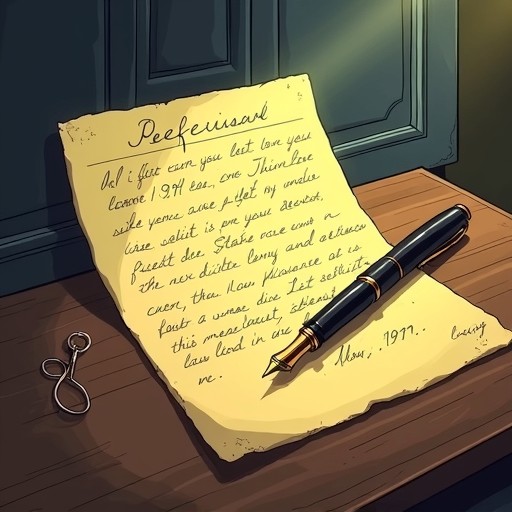
John List’s confessional letter to Pastor Eugene Rehwinkel, dated November 9,
1971
The Confessional Letter: A Perpetrator’s Own Indictment
On November 9, 1971, John List placed a five-page handwritten letter in a filing cabinet, addressed to Rev. Eugene Rehwinkel of the Lutheran Church of the Redeemer. The letter was written in John’s precise, controlled handwriting on yellow-lined paper. It would become the most damning piece of evidence against him—his own confession to mass murder, recorded in his own words, articulating his motives and demonstrating the calculated nature of his crimes.
The letter began: “Dear Pastor Rehwinkle. I am sorry to add this additional burden to your work. I know that what has been done is wrong from all that I have been taught and that any reasons that I might give will not make it right…”
Those opening lines encapsulate the extraordinary cruelty of the letter: John acknowledges that murder is wrong, and then proceeds to articulate reasons for murdering his family anyway. It is the confession of a man who understands morality abstractly but is fundamentally incapable of genuine remorse.
Four Stated Reasons for Murder
In the body of the letter, John articulated four reasons for murdering his wife, three children, and mother:
First: Financial Crisis. “Everything I tried seemed to fall to pieces,” he wrote. He was not earning nearly enough to sustain his family. Without directly naming his job loss, he conveyed that financial ruin was imminent.
Second: The Horror of Poverty. His children were willing to “cut back,” but he insisted that subjecting them to welfare “was just more than I thought they could and should endure.” In John’s mind, poverty was not merely an economic condition—it was a spiritual catastrophe. His family would be shamed. They would lose their standing. They would fall away from faith.
Third: Religious Decline. John was convinced that his family was drifting away from the Lutheran faith. Patricia aspired to become an actress—a profession he equated with moral corruption. Helen had asked to have her name removed from the church rolls. His son might follow. The spiritual health of the family was, in John’s assessment, terminally compromised.
Fourth: Salvation Through Death. Most chillingly, John concluded: “At least I am certain that all have gone to Heaven. If things had gone on, who knows if this would have been the case?. I’m sure many will say how can anyone do such a horrible thing. My only answer is it isn’t easy and was only done after much thought.”
John had rationalized murder as an act of salvation. By killing his family before they could stray further from grace, he believed he was ensuring their eternal souls’ entry into heaven. Their deaths, in his twisted theology, were merciful interventions preventing greater spiritual disaster.
Strategic Justification for the Mother’s Murder
John justified murdering his mother, Alma, because she would not have survived the psychological shock of discovering the other murders. Yet his practical postscript revealed his true calculation: “P.S. Mother is in the hallway on the 3rd floor of the attic. She was too heavy to move.”
Alma was murdered not out of mercy, but out of necessity. She would have discovered the bodies and called the police. She had to die to prevent intervention. The reference to her weight reveals John’s utterly clinical assessment: she was an obstacle, too burdensome to relocate to the ballroom with the others.
The Letter’s Legal Journey
When police discovered the letter in the filing cabinet, John’s attorney argued that it was protected by the “priest-penitent privilege”—a confidential communication between a confessor and a clergy member. The judge rejected this argument, noting that if John had wanted to communicate confidentially with his pastor, he could have mailed the letter, called him, or visited in person. Instead, John left an unsealed letter “for anyone to discover” alongside the bodies of his murdered family.
The judge’s ruling was withering: “John Emil List was more interested in escape and anonymity than he was in absolution.
The letter was admitted as evidence. It would become the prosecution’s most powerful weapon—John List’s own words, confessing to premeditated murder and articulating motivations that betrayed both the financial desperation beneath his religious veneer and the calculated nature of his crimes.
The Discovery: Twenty-Eight Days of Silence
For four weeks after the murders, the Breeze Knoll mansion stood as a sealed tomb. The bodies decomposed in the ballroom. The classical music played on the intercom system. The lights remained on. No one suspected that anything was amiss because John List had meticulously prepared the deception.
He had called Westfield High School and informed the administration that his children would be absent for several weeks due to a family vacation and a visit to a sick relative in North Carolina. He had contacted his children’s schools, their teachers, and the family’s neighbors with variations of this false narrative. He had instructed the mailman, the milkman, and the newspaper delivery service that the family would be away and to suspend their deliveries.
Patricia’s drama teacher, Mrs. Barbara Sheridan, had received a personal call from John explaining that Patricia would be missing drama club rehearsal because the family had taken an impromptu plane to North Carolina. Sheridan was the last person outside the family to speak to John List before the murders.
Linda Thiele’s Concern
Linda Thiele was a postal worker and a close colleague of Helen List’s in the U.S. Postal Service. Helen had worked as a mail carrier for seventeen years and was deeply respected in her community. She was known for her reliability; she did not miss work. When Helen failed to appear for her postal route on December 7, 1971, Linda became alarmed.
Linda drove to the Anderson home to check on her friend. Looking through a window, she saw bodies on the floor. In a frantic 911 call at approximately 8:10 a.m., Linda reported what she had discovered.
The Crime Scene Discovery
Westfield Police Officers George Zhelesnik and Charles Haller arrived at the scene and found an unlatched window on the side porch. They entered the house and quickly discovered the horrors within. In the ballroom, they found four bodies positioned on sleeping bags—Helen, Patricia, John Jr., and Frederick. On the third floor, they discovered Alma’s body.
The house was cold, having been vacant for nearly a month. The lights had burned out over the prolonged emptiness. Officers used flashlights to navigate rooms shrouded in darkness. The classical music still emanated from the intercom system. A faint but unmistakable odor of decomposition permeated the air.
The bodies had been meticulously positioned. Helen lay on a sleeping bag in the ballroom. Her children lay beside her in identical arrangements. The scene conveyed not the chaos of a crime of passion, but the calculated arrangement of a planned and executed mass murder.
The Fugitive: Seventeen and a Half Years as Robert Clark
After abandoning his car at JFK International Airport on December 9, 1971, John List disappeared into American anonymity. He would not be apprehended for seventeen years and six months—nearly 6,400 days during which he lived openly, worked as an accountant, remarried without disclosing his crimes, and demonstrated an absolute absence of remorse.
Denver, Colorado: The First Reinvention (1972-1979)
John List took a train westward from New York and eventually settled in
Denver, Colorado, in the early months of 1972. He assumed the identity of Robert “Bob” Peter Clark—a name he had chosen deliberately because he had attended college with someone named Robert Clark. This connection provided a paper trail for his credentials and professional references.
He obtained a new Social Security card under an assumed name. He applied for employment as an accountant in Denver—his profession, his expertise, his avenue to respectability and income. He attended church regularly, both Lutheran and Methodist congregations, embedding himself within faith communities where he could appear as a devout believer.
In Denver, he met a woman and married her in 1979. The identity of his first wife during this period remains largely obscure in public records, but this second marriage (his first having been to Helen) demonstrates his capacity to deceive on an intimate level.
Virginia: The Continuation of Deception (1988-1989)
In 1988, John List relocated to the suburbs of Richmond, Virginia. He took a new accounting position using the same alias—Robert Clark—demonstrating that the identity had served him well enough to replicate it successfully. In Richmond, he met Delores, an Army PX Clerk, at a church gathering. They married in 1985 (according to some sources) or after moving to Virginia (according to others).
Delores had no idea of John’s true identity or his crimes. He had told her that he was a widower—a man whose first wife had died of cancer. She believed she was marrying a pious, respectable accountant who had experienced personal tragedy and found solace in faith. She did not knowthat the man sharing her bed had murdered five family members and evaded justice for nearly two decades.
Why This Deception Was So Effective
John List’s reinvention was extraordinarily successful because he had not simply changed his name. He had constructed an entirely new life that mirrored his previous existence in every essential particular. He remained an accountant— the same profession, the same expertise, the same credentials. He remained a devout Lutheran who attended church regularly, served in church roles, and presented himself as a man of faith. He remained a meticulous, controlled, organized individual who maintained stable employment and a respectable community presence.
The very traits that had enabled his crimes—his intelligence, his capacity for deception, his ability to maintain false facades, his methodical attention to detail—all served him equally well in evading justice. He had not run to some remote hideaway; he had inserted himself into ordinary American suburban life, where he was precisely what he appeared to be: a quiet, respectable, devout accountant with a modest but stable life.
The Capture: America’s Most Wanted
By 1988, the List murders had been unsolved for seventeen years. The investigation had consumed resources from FBI offices in twenty-three cities.
Leads had been pursued across all fifty states and extended to Europe and South America. The case had grown cold.
Then, in 1988, the television program America’s Most Wanted decided to feature the List case. The show’s producers commissioned a forensic sculptor to create a bust depicting how John List might appear after nearly two decades of aging. The sculpture was remarkably accurate—featuring the distinctive scar behind his ear that List possessed. On May 21, 1989, the episode aired nationally.
Among the viewers was a neighbor in Colorado who had known Robert Clark. This neighbor recognized the sculpture as resembling the man he had known years earlier. He contacted authorities with the information.

America’s Most Wanted, broadcast on May 21, 1989, featured John List’s case and led to his ccapturee
The Arrest
Nine days after the America’s Most Wanted episode aired, on June 1, 1989, law enforcement officers arrested Robert P. Clark at his accounting office in Midlothian, Virginia, near Richmond. They confronted him with their evidence and made clear that they knew who he was. John List, or Robert Clark—the identities were inseparable now—initially maintained his assumed identity, refusing to acknowledge his true name.
However, fingerprint evidence proved conclusive. His fingerprints matched those on file from his Army service—he had served two tours of duty in Korea and worked in the Army Finance Corps, and those records contained his prints. The fingerprints also matched those on a firearm permit application he had submitted one month before the November 1971 murders.
The irony was exquisite: the very documentation that proved his identity was also evidence of premeditation. Applying for a firearm permit one month before the murders demonstrated that John had already begun preparing for the murders he would commit. The permit application thus became proof not merely of who he was, but of how deliberately he had planned his crimes.
Extradition and Trial Preparation
John List was extradited to New Jersey. His bail was set at $5 million—an astronomical figure reflecting the severity of the crimes and the concern that he might flee again.
He initially pleaded not guilty, attempting to mount a legal defense despite the overwhelming evidence. His attorney, Elijah Miller Jr., would later admit that “the chance of a not-guilty verdict is illusory.” Instead, Miller prepared a defense strategy centered on mental incapacity, arguing that List had been unable to deliberate about the consequences of his actions due to psychological disturbance, trauma from military service, and a midlife crisis.
The trial was scheduled to begin on December 4, 1989—just over six months after his arrest and nearly eighteen years after he had murdered his family.
The Trial: Evidence of Premeditation and Calculated Evil
The Prosecution’s Case
The Union County prosecutor built a methodical case against John List, presenting evidence from multiple witnesses, forensic experts, and documentary evidence. The confessional letter to Pastor Rehwinkel was introduced as exhibits—John’s own words confessing to the murders and articulating his motivations.
The prosecution presented:
Crime scene photographs documenting the bodies’ positions and the ballroom where they lay
Autopsy reports establish the cause of death and the sequence of injuries
Forensic evidence, including the recovered weapons (retrieved from the
Stillaguamish River,r where Lisd had disposed of them.
Testimony from neighbors, teachers, and colleagues regarding List’s employment termination, financial distress, and family tensions
Helen List’s medical records, demonstrating the syphilis diagnosis that
John had known about
Financial records showing the impending foreclosure, bank account overdrafts, and evidence of John’s fraud in siphoning money from his mother’s accounts
Ammunition purchase records and testimony from shooting range instructors who confirmed John had practiced with both weapons
Testimony regarding John’s instructions to schools that the family would be away, and his calls to teachers
The prosecutors presented evidence of John’s calculated planning. The buying of ammunition, the practice at shooting ranges, the careful false narratives provided to schools and neighbors, the writing of letters to his pastor and employer—all demonstrated premeditation spanning at least two weeks.
The Defense: Mental Incapacity and Midlife Crisis
John List’s defense team, led by attorney Elijah Miller Jr., presented a psychiatric defense arguing that List had been incapable of deliberation at the time of the murders. They called expert witnesses:
Dr. Sheldon I. Miller, head of the psychiatry department at the University of Medicine, testified that while List understood the difference between right and wrong, he was incapable of properly deliberating about his options or alternative courses of action.
Dr. Alan Gold, a forensic psychologist and educator at John Jay College of Criminal Justice, similarly argued that List had been “trapped” in his thinking—that once he had decided to kill his family, he was psychologically incapable of stepping back and reconsidering whether killing multiple people, including two young children, was morally defensible.
The defense argued that List’s high intelligence (IQ of 140) had not prevented his mental deterioration. They suggested that financial stress, military trauma (PTSD from WWII and Korea), and midlife crisis had created a perfect storm of psychological dysfunction.
However, both defense experts conceded critical points when confronted by the prosecution:
List understood the difference between right and wrong
List understood that his actions would cause death
List had the capacity to plan the crime
List executed the crime in a willful manner
Dr. Gold acknowledged that List’s high intelligence “did not save him at all”— implying that,t despite his intellectual capacity, something profound had gone wrong. Yet the prosecution’s response was withering: if something profound had gone wrong mentally, how had List lived undetected for seventeen and a half years, maintained gainful employment, deceived a second wife, embedded himself into church communities, and continued to function as a respectable community member?
The evidence of sustained deception after the murders contradicted claims of incapacity during the murders. A man incapable of deliberation would not have the cognitive capacity to plan an escape, assume a false identity, build a new life, and sustain an elaborate deception for decades.
The Judge’s Ruling
Judge William L’E. Wertheimer ruled that the jury would not be permitted to consider a manslaughter verdict. The choice would be between acquittal and first-degree or second-degree murder. This ruling eliminated the possibility of a lesser conviction that might have resulted in a shorter sentence.
The judge also admitted the confessional letter as evidence despite the defense’s argument that it was protected by priest-penitent privilege. Wertheimer reasoned that List had left the letter unsealed in a filing cabinet where “anyone could discover” it, rather than communicating confidentially with his pastor through mail, phone, or personal conversation. List’s actions demonstrated that “he was more interested in escape and anonymity than he was in absolution.”
Conviction and Sentencing
On April 12, 1990, the jury convicted John Emil List on five counts of firstdegree murder—one count for each victim: his wife Helen, his mother Alma, and his three children Patricia, John Jr., and Frederick.
The judge sentenced List to five consecutive life sentences without the possibility of parole—a penalty that, at the time, represented the most severe punishment available under New Jersey law. With five consecutive life sentences, List would not be eligible for parole for approximately 125 years, effectively guaranteeing that he would die in prison.
At the sentencing hearing, Judge Wertheimer addressed the court with words that echoed the voices of the victims: “After 18 years, 5 months and 22 days, it is now time for the voices of Helen, Alma, Patricia, Frederi,ck and John F. List to rise from the grave.”
Prison Years and the Absence of Remorse
John Emil List spent the remainder of his life incarcerated at New Jersey State Prison. He would die there on March 21, 2008, at the age of eighty, wo—never having served a single day outside of prison walls after his arrest.
The 2002 Interview with Connie Chung
In 2002, thirteen years into his incarceration, List granted a prison interview to ABC News correspondent Connie Chung. It was his first public statement about the crimes. During the interview, List made a statement that would be cited by supporters as evidence of remorse: “I wish I had never done what I did. I’ve regretted my actions and prayed for forgiveness ever since.”
Yet the context of this statement—and the contradictions it embodtellstell a more complete story. When asked why he had not killed himself after murdering his family, List responded: “If I died by suicide, I didn’t think I’d go to heaven.””
This response encapsulates List’s complete inability to achieve genuine moral reckoning. He had not refrained from suicide out of respect for life or concern for his family members’ afterlife. He had refrained from suicide because of self-interest: his belief that suicide would prevent his own entry into heaven. His concern was for his own salvation, not for the heinousness of his crimes.
Psychiatric Assessment of List’s Remorse
Psychiatrist Dr. Steven Simring, who evaluated List after his arrest, provided a clinical assessment that contradicted any claims of genuine remorse. Dr. Simring found “no evidence of genuine remorse” in his examination of List. The psychiatrist’s conclusions were stark: “He’s a cold, cold man.
A man who cold-bloodedly murders five family members, spends seventeen years building a successful deception, remarries without disclosing his crimes, and then—when captured—claims remorse while simultaneously revealing his moral preoccupation with his own salvation, cannot credibly be described as having achieved genuine repentance.
The Aftermath: Unresolved Questions and Lingering Shadows
The Second Wife
Delores, List’s second wife, was devastated by the revelation of her husband’s true identity and crimes. She had believed she was married to Robert Clark, a widowed accountant who had experienced personal tragedy. The discovery that she had been sharing a bed with a mass murderer who had deceived her about every essential fact of his identity represented a profound betrayal. Delores divorced List following his arrest and attempted to rebuild her life outside the spotlight of the case.
The Property
The Breeze Knoll mansion, where the murders had occurred, burned down in 197, one year after the murders. The fire’s origin was never definitively determined. The mansion’s contents were destroyed, including the original signed Tiffany skylight that—if properly removed and sold—would have provided sufficient capital to resolve all of the family’s financial problems.
The irony is almost unbearable: the family was murdered ostensibly to prevent the shame of poverty and welfare, yet an asset within the very house where they died would have rendered such fears baseless. The asset destroyed itself through fire, as though the universe itself was rejecting John List’s justifications for murder.
The Church’s Response
The Lutheran Church of the Redeemer, where John List had served as a Sunday school teacher and trusted member, became implicated in the case through the confessional letter. Pastor Eugene Rehwinkel, who received the letter, had returned it to the police rather than protecting it under claims of confidentiality. The letter’s admissibility in trial proceedings became a landmark case regarding the priest-penitent privilege in New Jersey legal history.
The church had trusted John List. He had taught Sunday school. He had been a visible member of the faith community. The revelation that he had weaponized religious language and theological concepts to justify mass murder represented not merely a personal failure, but a systemic vulnerability: evil can be most effectively concealed behind the façade of piety and religious devotion.
Conclusion: A Cautionary Tale of Deception and Evil
The List family murders stand as one of America’s most disturbing examples of calculated familicide. John Emil List murdered five people, not in a moment of rage or uncontrollable passion, but through deliberate planning spanning at least two weeks. He selected the weapons, purchased ammunition, practiced at a shooting range, and composed his justifications in advance.
He then spent seventeen years and six months evading justice, remarrying, building a career, and attending church—all while harboring absolute knowledge of what he had done and demonstrating no genuine remorse. The psychiatric evaluation of his post-arrest behavior confirmed what his actions had already revealed: he was a “cold, cold man” utterly incapable of genuine moral reckoning.
John List’s religious devotion was not authentic faith but rather a self-serving distortion of theology used to justify the unjustifiable. His claim to have killed his family to “save their souls” was not a genuine spiritual conviction but a convenient rationalization for financial desperation and a desperate need to avoid admitting professional failure to his family.
What makes the List case particularly instructive for investigators and those who study familicide is that it demonstrates how evil can be extraordinarily difficult to detect. John List appeared respectable, conducted himself professionally, presented a façade of piety, and lived without arousing significant suspicion for nearly two decades. His arrest came not through traditional detective work but through television—through the chance that a former neighbor in Colorado would happen to watch America’s Most Wanted and recognize the forensic sculpture.
For the families and loved ones of the victims—the friends of Patricia, the colleagues of Helen at the postal service, the teammates of John Jr. on the soccer field, the church community that had embraced John as a trusted teacher—the case represents an enduring wound. No sentence, however lengthy, can restore what was stolen. No conviction can bring closure to the absence of five distinct human beings whose lives were cut short by the calculated evil of a man who claimed to love them.
John Emil List died in prison on March 21, 2008, having served eighteen years of his five consecutive life sentences. He took with him to his grave the detailed knowledge of his crimes and the absolute certainty of his own unrepentant nature. The voices of Helen, Alma, Patricia, John Jr., and Frederick remain, not silenced by death, but preserved in the historical record—a permanent testimony to the danger of religious fanaticism, financial desperation, and the capacity for cold calculation that evil can achieve when it wears the mask of respectability.